Leadership
in 2026 and beyond
Leadership is Getting Harder. It's Not Your Imagination.
When was the last time you had time to think? That your nervous system felt relaxed, not scanning for the next thing to do, to achieve. That you felt there was time and space to connect with your team, your family, properly. Not just being there but being present.
I tend to work with leaders navigating significant transitions: a new role, a strategy change, an organisation that's moved under their feet. Lately I've realised, all leaders feel in a kind of transition. The ground is moving for everyone, and I wonder if we're prepared.
Leadership has always been demanding.
Over the last decade or so it's felt like not one crisis but many, each arriving before the last had cleared. What's changed isn't the difficulty of the work. It's the relentlessness.
The 2008 financial crisis didn't just cause economic damage; it installed a new operating assumption across most organisations: do more with less. Austerity wasn't a temporary phase for many sectors, it became the permanent baseline.
Brexit added years of strategic uncertainty on top. Then Covid arrived: first as acute crisis, then as a fundamental restructuring of how, where and why people work.
Supply chains fragmented. Inflation returned. Geopolitical instability became a planning variable rather than a distant concern.
Each wave receded, but it didn't fully clear. The next one arrived before the previous one had settled.
The result is what researchers at the CBI, Resolution Foundation and Deloitte now describe as rolling complexity: no longer a crisis to recover from, but a permanent condition to lead through.
Work-related stress has reached record levels in UK workplaces. Twenty-two million working days were lost to stress in 2024/25. The number of workers reporting stress, depression or anxiety rose from 776,000 to 964,000 in a single year. One in three UK employees faced mental health challenges in 2024, with a quarter reporting a deterioration over the year.
UK business confidence has been in negative territory for much of the past three years, with the ICAEW Business Confidence Index falling to -20.8 among non-exporters in Q4 2025.
These aren't figures about weak people. They're figures about a system running under sustained load.
There's a useful neurological lens for understanding why this feels the way it does. David Rock's SCARF model, drawn from neuroscience research, identifies five domains the human brain continuously monitors for threat or reward.
When any one of them feels under pressure, the brain's threat response activates.
The prefrontal cortex, the part responsible for judgement, strategic thinking and reading complex situations, starts to go offline.
The brain shifts from considered to reactive.
Five domains the brain continuously monitors for threat or reward. Threat in any one of them activates the same neural response as physical danger. Higher-order thinking goes offline. The habit-driven, reactive brain takes over.
The brain doesn't distinguish between social and physical threat. The response is the same. The conditions of the past fifteen years have been pressing on all five domains simultaneously.
AI as the latest pressure
Ethan Mollick, Professor at Wharton and author of Co-Intelligence, describes AI as a general purpose technology, in the same category as electricity or the internet. Much the same as when electricity was introduced, AI is a foundational shift that will eventually touch every sector and every role, but whose full trajectory, speed and sectoral impact we can't yet fully predict.
We also know something specific about its psychological impact. AI activates every SCARF domain at once.
Status will my expertise still matter?
Certainty what will my role look like in two years?
Autonomy am I still in control of my own work?
Relatedness will I be left behind while others adapt?
Fairness is this being done to me or with me?
It's not just a harder market, or faster change, or a new technology to adopt. It's all at once.
For leaders already operating under sustained pressure, AI doesn't add a technical challenge to an otherwise manageable list. It turns up the volume on a nervous system that's already working hard.
AI and expertise
For most of the last century, expertise was the point. You built it over decades. AI closes that gap in months. Although expertise is needed to discern the quality of AI output, it's the strategic, creative and human elements which will become the differentiator.
Where leadership is strong, AI accelerates everything: clearer thinking, faster decisions, people who are invested and able to contribute fully. Where it isn't, it accelerates that too. AI doesn't change what good leadership requires. It removes the tolerance for not doing it. And it makes the leaders who do it well more valuable than ever.
Senior leadership has always required more than expertise. Rolling change and AI just amplify that.
Leadership as a discipline.
Often, technical competence is what gets someone promoted. The leaders who get noticed are the ones who fix things: who move fast, drive results, step in and get things done. Those qualities are genuinely valuable in individual contributors. The problem is that they become progressively less useful as someone moves up, and can actively work against the organisation once that person reaches senior level.
The hero model is often baked into how we select leaders, how we promote them and how we measure their success. It produces leaders who are highly capable as individuals, less so as leaders.
The CMI surveyed over 4,500 UK workers and managers. Eighty-two per cent of those entering management positions had received no formal management or leadership training. One in four people in the UK workforce holds a management role. Twenty-seven per cent of workers describe their manager as highly effective.
These aren't figures about bad people in wrong jobs. They describe a system that promotes on technical competence and then expects something structurally different to emerge, largely unaided.
The assumption has been that experience fills the gap. But on-the-job learning defaults to expertise accumulation. A systematic review of 73 studies (Wijga, Beausaert and Kyndt, 2024) found that experience only produces development when the conditions support it. Return someone to the wrong environment and experience produces nothing.
The wrong kind of preparation
The problem runs deeper than volume of experience.
We described earlier how the operating environment is now characterised by rolling complexity: no longer a crisis to recover from, but a permanent condition to lead through. So what kind of complexity are leaders actually prepared for?
Research by Maylor, Turner and Murray-Webster at Cranfield asked 246 project managers two questions: which type of complexity do you find hardest to manage, and which has received most attention in your formal training?
The answers sat in direct contrast. 68% found sociopolitical complexity the hardest: the people, politics, power dynamics and competing agendas that shape what actually gets done. Yet 87% said their training had focused on structural complexity.
The irony is that structural complexity is the easiest kind. The harder kinds, sociopolitical and emergent, are what leadership actually demands most. Those are what get the least attention.
The nature of different types of complexity, and how to respond to each, is something we return to in the environment section.
What experience can develop, when the conditions are right, is something different.
Gallup's research across thousands of organisations finds that managers account for at least 70% of the variance in employee engagement.
Top-quartile business units achieve 23% higher profit than bottom-quartile units.
Lower absenteeism, lower turnover, fewer errors and higher customer loyalty.
The lever isn't strategy or technology. It's the quality of leadership people experience day to day.
Working with leaders over many years, and across the full range of coaching and development approaches, what strikes me is how much is covered: skills, knowledge, emotional intelligence, personality, political awareness. All of it matters. Leaders still need to develop. The question is what kind of development makes the difference.
Vertical development
Researchers in adult development theory: Loevinger, Torbert, Cook-Greuter, Kegan and others, have spent decades studying what we actually gain through experience beyond knowledge and skill. Their work points consistently to something they call vertical development: not an accumulation of what we know, but a shift in the complexity of how we think and how we show up. It's the difference between knowing more and seeing differently.
The Socialised Mind. Kegan identifies distinct stages in how adults make meaning of the world around them. Most leaders operate at stage 3: capable, conscientious, and shaped primarily by the expectations of others: their organisation, their role, their peers.
The Self-Authoring Mind. Stage 4 is the shift beyond that. It isn't about accumulating more expertise. It's a change in identity: moving from a self defined by others' expectations to one that can hold its own compass under pressure. Breadth of perspective replaces the need for certainty. Ego becomes less of an obstacle to clear thinking.
Kegan argues that the demands of senior leadership require stage 4 functioning: the complexity, the competing pressures, the absence of clear answers.
This shift typically happens in adulthood, often between the late thirties and fifties: it happens, if it happens at all, largely in the workplace.
Kegan's research suggests that currently only around 35 per cent of adults reach this stage. The rest are capable. They haven't been in conditions that supported it.
Moving to self-authorship in midlife is critical to staying sane with the plethora of demands and responsibilities adults face, especially as senior leaders.
Research into vertical development shows consistent results:
More systemic thinking.
Greater resilience under pressure: less likely to be destabilised by competing demands.
The genuine capacity to hold complexity rather than collapse it into the nearest familiar answer.
Greater effectiveness in leading change.
Stronger trust across teams.
The WEF's Future of Jobs research, drawing on over 1,000 employers and 14 million workers, identifies the skills that will matter most over the next five years.
Analytical thinking, resilience, leadership and social influence, creative thinking, self-awareness.
These aren't new skills. They're what vertical development builds, and what sustained pressure erodes.
Vertical development at work
At first glance the concept of vertical development feels disconnected from the day job. In fact, it underpins what we need to line up to succeed as soon as the job gets to a level of complexity. If you think about the WEF future skills, they're all internal: how we show up and what we pay attention to, in ourselves and others.
Vertical development isn't an academic concept. It's the process of becoming more capable of holding complexity.
It happens at work, through work, through challenges that stretch how you see yourself and your situation, not just what you can do.
Vertical development is what good leadership development and coaching actually do.
Experience alone doesn't guarantee growth. Without this internal work, leaders accumulate years without accumulating capacity.
Vertical development involves developing discernment, breadth of perspective, reducing binary thinking, developing our empathy, and balancing our ego.
Two key areas to explore, especially for leaders in transition, are identity and self-permission.
Identity
Who you need to become, not just what you need to do differently.
Permission to be human
To stay regulated, present and human when the pressure is relentless.
Focusing on these helps leaders move from being the expert who tells people about leadership, to living it.
The identity gap.
When the role changes, what's needed to succeed in it changes too. The skills and behaviours that worked before may not be the ones this new context requires, and that means shifting not just what you do but how you see yourself and where you believe your value lies.
That's why it's hard.
William Bridges drew an important distinction between change and transition. Change is the external event: the new role, the restructure, the strategy shift.
Transition is the internal psychological process people go through in response to it. The two don't run on the same timeline.
His key finding was that most change management focuses entirely on the external event and skips the internal transition. Leaders are expected to be performing in the new role from day one, while internally they may still be in Ending or the Neutral Zone.
Coaching support at this point makes a disproportionate difference to success in the new role.
It's common for leaders to think they got promoted for what they do and continue to do what they did before, now in a bigger job. In Bridges' terms, they never fully completed the Ending: they carried the old identity and the old measures of success straight into the new role. Professor Cliff Bowman of Cranfield University describes the result. He calls it negative delegation: strategic leaders sucking up the work, over-controlling and working hard to cast an unproductive shadow across their organisation.
If people never let go of what served them before, they can become quite senior and still be relying on the individual expertise that made them successful at the start of their career. That casts a long, unproductive shadow across the organisation. Described as a shadow, because they can't see it.
Rolling complexity and AI take away the space for leaders to do this. The shift in identity to match new demands is key.
Adoption of AI as a form of transition
For many leaders and their people, the arrival of AI as a genuine working tool isn't just a technical change. In Bridges' terms, it's also a transition:
Ending An identity built around expertise and hard-won knowledge begins to feel under threat.
Neutral Zone The old measures of value no longer hold and the new ones aren't yet clear. Disorienting, but also the space where something new can form.
New Beginning With the right conditions, a different kind of contribution becomes real.
Understanding that your people are moving through these stages, at different speeds and with different degrees of awareness, is part of the leadership work.
Coaches and leaders need to have done this work themselves before they can hold the space for others to do it.
Leadership under pressure.
Leadership operates under pressure. The right level sharpens thinking, drives performance, and keeps people engaged. Leaders who create a degree of stretch in their systems are doing their job well.
The question is whether the system stays in that productive range, or tips into distress: where pressure stops driving performance and starts undermining it.
Professor Amy Arnsten of Yale School of Medicine has spent decades studying what stress does to the brain. Her finding is direct. Under acute stress, the prefrontal cortex goes offline: the part of the brain needed most at senior level. Under pressure, the brain switches from thoughtful to automatic. The habit-driven part takes over.
Under sustained pressure, the brain narrows its attention onto immediate tasks and problems. What gets lost is peripheral vision, including awareness of the people around you. They stop registering as fully as they should. This isn't callousness. It's simply that sustained pressure removes the capacity to see clearly.
A leader under sustained pressure isn't underperforming through lack of effort or capability. The thinking the role requires has been switched off by the pressure itself. Arnsten notes that awareness of this mechanism makes a practical difference. Knowing what's happening, and having the capacity to pause, can restore the function that pressure has suppressed.
Permission to be human
Growing self-awareness needs to be matched by self-acceptance: not as a way to refuse to change, but to embrace our human needs within that change. We need to give ourselves, and those around us, permission to be human.
That means tending to the layers that make us capable: our body, our nervous system, our emotions, our brain, our connections to others. All of them matter. Without that attention, we become reactive and less able to meet the demands of senior leadership.
This is hard. When jobs get more demanding, the instinct is to work harder to get through it. The odd wellbeing day or holding out for the next holiday doesn't suffice.
We used to get away with it when there were peaks and troughs. Now, with rolling complexity, it leads to poor judgement, burn-out, and ultimately shorter lives.
Coaching and development play a critical role in helping leaders and their teams navigate how to be human under these demands.
What also helps is becoming aware of our own habits and patterns under stress. Not to judge them, but to recognise and manage them before they manage us.
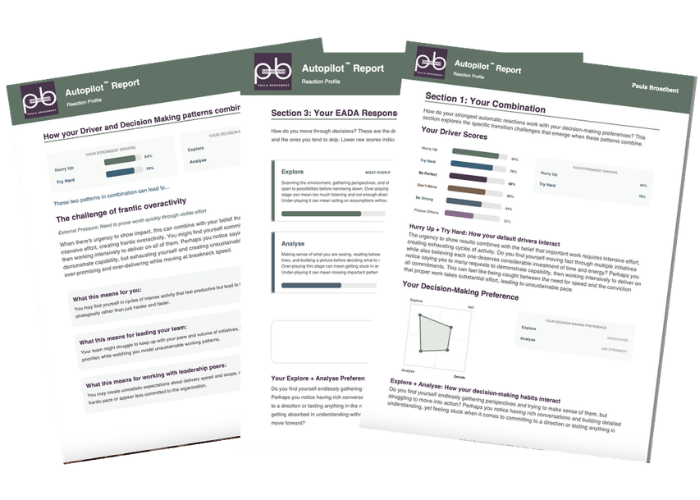
Autopilot™
A diagnostic for understanding reaction habits under pressure, for leaders and leadership teams
Broadbent, P. (forthcoming). Reading the Weather: A Strategic Leadership Framework. Paula Broadbent Consulting.I built Autopilot™ from a consistent observation: under pressure, leaders stop responding to what's actually in front of them and start reacting from habit. The question is which habits, and what they're producing.
The diagnostic reads two sets of automatic responses. The first is your Driver reactions: patterns developed in early life as problem-solving strategies, distinct from personality traits though related to them. They sit alongside personality, show up most strongly under pressure, and become comfort blankets precisely when clear thinking matters most. Because they're stress-activated and learned rather than structurally fixed, they're interruptible: once visible, they can be managed.
The second is your Leadership Response Cycle™ preference: how you habitually move through decision-making, whether you naturally start by exploring widely, analysing deeply, deciding quickly or acting to test your thinking.
Both operate below conscious awareness. That's the point. They're your autopilot: your automatically operating system unless you choose to disrupt it. Knowing what your autopilot is doing is the first step to leading from choice rather than reflex.
It works at the individual level and in composite across a leadership team. Where patterns align and where they diverge tells you something important about how the team makes decisions under pressure, and where the gaps are.
I use it with individual leaders in Land Well, with senior leadership teams in Common Ground, and as a development tool in the Leadership Transition Programme.
The permission to be human. Then the discipline.
Scott Dick, General Manager, Breedon Group Scotland
Cranfield General Management Programme
Scott came to a Cranfield General Management Programme with a pattern many senior leaders will recognise. His senior team was working evenings, weekends and holidays as routine. Too many decisions were escalating to the wrong level. Firefighting had crowded out strategic thinking.
The reframe that shifted things was simple: behaviour is a function of person and environment. His job was to shape both. Not with a transformation initiative. With small, visible changes and short feedback loops. Clearer decision rights. Short focused check-ins replacing sprawling meetings. Protected thinking time. Boundaries on out-of-hours contact as the default, not the exception.
Escalations to GM level fell from seven to three per week. Right-level decisions went from 52 per cent to 80 per cent. After-hours emails fell from 72 to 23 per week. By October 2025, Breedon Scotland's underlying EBIT was up 26 per cent on revenue that was down 6 per cent. Profitable growth in a difficult market, achieved not by pushing harder but by removing the friction consuming the organisation's energy before it ever reached the work.
"The team described it simply: calmer and faster."
Scott's story is an example of a leader giving himself, and his team, permission to regulate. To create the space and pace that allowed people to actually think. The results followed.
That permission doesn't always exist. When it doesn't, behaviour from the top amplifies conditions all the way down the system. Leaders under pressure create pressurised environments. People disconnect from the purpose of their work, focused instead on the immediate, the urgent, the task in front of them. The unintended consequences land on the front line, the end user, the customer, in ways nobody at the top ever intended or can easily see.
Situational leadership.
Kurt Lewin put it plainly: behaviour is a function of a person in their environment. Not one or the other. Both, in interaction. Change what a person brings to a situation, and behaviour shifts. Change the conditions they're operating in, and behaviour shifts. Work on both, and you change the system.
Leadership development needs to take account of both sides of that equation. Programmes tend to focus on the person: skills, personality, style, awareness. Organisational change tends to focus on the environment: structure, process, systems. The interaction between the two, which is where leadership behaviour actually lives, gets the least attention of all.
Both sides matter. Who you are under pressure, how you see yourself and your role, and what your habituated responses do to the people around you. And the conditions you're operating in: what they are actually producing, whether you're reading them accurately, and what it takes to change them deliberately. Two sides of the same practice.
The research makes this concrete.
Moving organisation is a common and yet underestimated leadership challenge. Most leaders assume their capability will travel with them. The research suggests otherwise.
A Wharton study, aptly titled 'Pay More, Get Less', compared external appointments with those promoted from within:
Paid around 18% more
Performed significantly worse for their first two years
61% more likely to be let go
Bidwell studied this across multiple industries and settings. His findings were consistent.
Much of what looks like individual capability is context-dependent.
The organisational knowledge, the relationships, the networks, the unwritten rules: these took years to build and don't cross with you when you move. In a new organisation, you don't yet know what you don't know.
Leaders continue doing what made them successful before, without fully registering that the context has changed.
This is what Nicholson identifies as the most common default in any role transition: replication. The approach needs to change with it.
What Nicholson describes as a behavioural default, Petriglieri's research on identity threat identifies as something deeper. The transition isn't just a change in role. It's a challenge to who the leader understands themselves to be. When the context that shaped that identity is removed, the identity itself feels at risk.
Leadership isn't just a personality trait that travels intact from one context to the next. It isn't held in the person alone. It's held in how that person reads and responds to the specific environment they're in.
This is true whether we are changing role or organisation, our team has changed, our strategy has shifted, or expectations have changed because of new technology. The environment is changing, and we need to understand it and be in a position to respond.
The shift from managing what you have to leading your area
One of the biggest shifts a leader faces is when they move into a role which is less about understanding and managing the environment they're given, and becomes about leading the system itself. This happens in stages: leading your team, your function, your business unit, all whilst managing the conditions others are leading around you. Gaining clarity on where you manage what you have, and where you have the opportunity to lead the system yourself, is a critical part of organisational leadership.
Change the environment, and the leadership has to be rebuilt.
The 5Ps of Leadership Authority™
The 5Ps of Leadership Authority™ is a framework built to bring Lewin's equation into action.
Why we show up
Purpose
Clarity of intent: for your organisation, your team, yourself. Maintaining that perspective over time, keeping an eye not only on outcomes but ensuring they don't drift from original purpose. Purpose is the anchor that stops rolling change from feeling like rolling chaos. It is the why that prevents the other four dimensions from becoming aimless or reactionary.
How we show up
Presence
How you inhabit the many roles you play: peer, leader, expert. Knowing which version of your authority the moment actually requires, and being fully there rather than just being the person in the chair. How you show up, what you attend to, and the altitude at which you operate are signals the organisation reads continuously.
Pace
There is a frantic energy that comes from confusing activity with productivity. True seniority is the ability to set a deliberate tempo, resisting the external pressure to just do something, so you can focus on doing the right thing. Choosing not to move, when everything is pushing for movement, is one of the hardest and most underrated things a senior leader can do.
What we pay attention to
People
As soon as we lead those who lead others, people are before task. This is about understanding self and others across the full breadth of stakeholders your role carries: peers, boards, teams, all with different needs and often wanting different things at the same time. The complex, often messy web of relationships is rarely about simple leadership: it is about navigating competing needs with skill.
Place
Reading the room, gaining and maintaining clarity of context. Noticing the interactions, what is focused on and what is missed, the conversations that aren't being had. If you are still leading the way you did eighteen months ago, you are likely solving problems that no longer exist. Place is about matching your approach to the current terrain.
The Leadership Discipline
To show up in these ways consistently, when leading through continuous challenge, is difficult. It requires a structure: a discipline of ongoing practice. Otherwise, our leadership can get lost into day to day demands, effectively rendering our organisations leaderless.
It's also what AI adoption requires: not a project with an end point, but a continuous loop of hypothesis, test and response.
The Leadership Response Cycle™
A framework to pull together the what and how of strategic leadership into an ongoing discipline.
The Leadership Response Cycle™
5Ps of Leadership Authority™
This is an ongoing cycle. It is not designed to end, it is the framework for an ongoing leadership discipline. It is atelic.
Atelic
from the Greek: without a fixed end point
An atelic practice is one whose value lies in the ongoing doing of it: purposeful, disciplined, continuous. Many leadership outcomes have an end point, they're 'telic'. Leadership itself is different. It has no finishing line. The cycle completes and begins again.
Leadership itself is not 'telic'. It has no finishing line. It cycles: reading the situation, responding to it, learning from what that reveals. That's the nature of the discipline, and it's what's most often missing.
To apply this practice we need to understand the context in which we're leading. Situational leadership demands we read our current situation clearly, and manage what it requires of us.
Reading the Room.
In many cases, the skills that got you the promotion are expertise, execution and problem-solving. These are the right tools for complicated problems. Yet, the more senior you become, the more you encounter problems that won't yield to those tools.
Most leaders have a clear read of the tasks in front of them. Fewer have an equally clear picture of the conditions those tasks need in order to land. That's a different question which requires a different focus of attention.
What you can control, what you can influence, and what you must accept
A clear-eyed read of your environment starts with understanding your relationship to it.
What sits within your direct control: your own decisions, behaviour, priorities, how you show up. What sits within your circle of influence: the conditions you can shape, the relationships you can build, the direction you can set. What sits in the circle of concern: the factors you must understand, accept and adapt to rather than attempt to control.
For leaders working within a system, this clarity alone is valuable. Knowing where to focus attention, what to act on and what to accept, is one of the most practical things a leader can do. It cuts noise and concentrates effort where it can land.
Positioning yourself as leader
As you take on more leadership responsibility, that boundary shifts. A promotion or structural change may move someone from operating within part of a system to leading it. What was previously in the circle of concern: the overall direction, the culture, the operating conditions, may now sit in the circle of influence or control.
Knowing what is yours to lead, and claiming it rather than waiting for permission, is how you position yourself fully as leader, not follower, in your new role.
Leadership awareness
The more senior you become, the less direct contact you have with what's actually happening on the ground. At exactly the point you're expected to make decisions affecting a broader area, you're further away from the understanding you need.
In transition this is amplified. Things have changed, especially if you're coming in from outside. People are watching.
Yet you don't have the tacit knowledge of this context, this team, this system. You don't yet know what you don't know.
You need additional ways of categorising and understanding the environment you're responsible for. You need different levers. What conditions am I responsible for, and what do they actually need?
Understanding current conditions
To do this we need to pay attention to different things: the current state of the system, its strategic capacity, where the constraints are, what it can realistically absorb, what needs to be built and in what order.
Those conditions are Define, Align, Engage and Enable. They work on two levels. They are the stages you move through to take an idea into action in an organisation. They are also a way to categorise the strategic capacity of the system you're leading right now. Together they answer the question that complexity makes urgent: what does this organisation actually need from me, and what can it currently absorb?
The gap between the ideal and the actual is where the most effective leadership work sits.
Define
Genuine clarity about what you're trying to do and why, translated into how every part of the organisation works. People can connect their daily work to the overall direction.
Align
Teams working across boundaries, not defending their patch. Shared accountability, clean handoffs, and collaboration that holds under pressure.
Engage
People bringing genuine energy and commitment to the work. Not manufactured enthusiasm: real investment rooted in feeling valued and part of something worth doing.
Enable
The tools, systems, processes and decision rights to get the job done. Effort converts to progress rather than being consumed by the same obstacles repeatedly.
The OrgBarometer™
A framework to understand organisational systems
Having a framework to cut through complexity is what makes the senior leadership job doable.
This is as true for leadership teams as it is for individual leaders. It's particularly important in transition: a new role, a new team, a new strategy.
Understanding the big levers to pull, the fewest things that will make the biggest difference at this point in time, turns the role from management of issues to leadership.
Whether you're mapping what you want to build or reading what's currently there, the sequence is the same.
You can't skip a stage, and you can't manufacture a later one while an earlier one is absent.
Define. Align. Engage. Enable. This sequence isn't arbitrary. It shows up consistently across different bodies of research.
The OrgBarometer™, Tuckman's stages of team formation and Kotter's eight steps of change management all arrive at the same pattern from different directions.
| OrgBarometer™ | Define | Align | Engage | Enable |
| Tuckman | Forming | Storming | Norming | Performing |
| Kotter | Urgency, coalition, vision | Communicate, remove barriers | Short-term wins, momentum | Anchor in culture |
Tuckman and Kotter's research is clear. Whether you are transitioning into a new role, forming a team, or implementing change, there is a sequence.
This is a leadership discipline. Trying to skip a stage, or force a later one before an earlier one is established, leads to poor results every time.
Mapping the conditions
Most leaders aren't building from scratch. They step into a role, inherit a team, or launch an initiative inside a system that already has some version of the Barometer conditions in place.
As a leader or leadership team, you'll have been recruited or formed to tackle a set of opportunities and challenges. You'll have your ideas for the future: the ideal. And you'll be facing the internal realities that will shape your plans: the actual.
The conditions build on each other, so the sequence matters. A gap in Define compounds through everything that follows.
Yet most leadership interventions focus on Enable, the visible and actionable layer, which is why so much of it produces whack-a-mole rather than genuine change.
The presenting condition is rarely where the problem started. Enable is where difficulties become visible: progress stalls, decisions bottleneck, effort goes in and little comes out. Visibility isn't origin.
A stuck Enable is almost always downstream of something in Define, Align or Engage that hasn't been addressed.
Forecasting the weather
Most leaders have a working sense of how things feel individually: whether the strategy is landing, whether teams are pulling together or defending their patch, whether people are genuinely invested or going through the motions. Those things can be observed, discussed, worked on directly. The more interesting question is what the conditions are producing in combination, because that combination creates something harder to see and harder to name.
When the conditions compound positively, momentum builds in ways that can feel almost effortless. When they compound negatively, the organisation consumes its own energy before it ever reaches the work.
The whole becomes significantly worse than the sum of its parts, and the reverse is equally true.
Goleman's research, drawing on nearly 4,000 executives, found that the conditions leaders create account for around a third of financial performance. The conditions created by the people at the top matter more than most leaders realise.
Goleman's climate diagnostics explore subsets of these conditions (clarity, standards, flexibility, rewards, responsibility and commitment) and the impact holds across each one. The weather at the top of the organisation becomes the weather people are working in at the front line, often in ways nobody at the top intended or can easily see.
Reading the state of the four Barometer conditions together gives you a forecast.
Not a verdict, but a prediction: if this is what Define, Align, Engage and Enable are producing in combination, this is what the organisation's weather is likely to look and feel like for the people inside it.
The more senior you become, the more removed you tend to be from the day-to-day experience of working inside the organisation you're leading, and at exactly the point when your decisions carry the most systemic weight, you have the least direct feel for what they're producing on the ground.
The children's ward
I was twelve the first time I was on the receiving end of conditions nobody was reading. I'd broken both bones in my lower leg and spent several days on a children's ward after surgery.
I, and other children on that ward, suffered psychological and physical harm from the nurses during our stay. We were treated as an inconvenience and so were our injuries.
What I witnessed over those days wasn't just unkindness; it was people under pressure, focused on time and the next task, who had stopped noticing the effect they were having. The children on that ward were living the weather while nobody at the top of that system was reading the forecast.
I've seen the same pattern in different industries and at different levels of seniority in the decades since, and it rarely starts with bad intent. It starts with conditions that nobody was paying attention to.
What shapes the Barometer conditions
Conditions combine to create consequences nobody intended. Tracing those back to the levers that actually matter, rather than the symptoms that are easiest to see, is what makes leadership genuinely hard. It's not that leaders aren't capable. Reading what's going on requires holding several layers simultaneously.
Define · Align · Engage · Enable
Cultural
The habits, norms and behaviours that have accumulated over time, often invisible to the people inside them because they're simply how things are here.
Structural
The systems, processes, infrastructure and measurement tools that either support or undermine what you're trying to create.
Strategic
Direction, purpose, priorities.
Relational
How people work together, trust between teams, the political dynamics that shape what actually happens.
Foundational
The basic conditions that make the work possible: resources, permissions, pace, infrastructure.
Both these cultural and structural pressures are formed by a variety of strategic, relational and foundational factors, providing what's often a unique fingerprint for each organisation.
Experienced leaders often build this understanding as a form of organisational awareness. Mapping it out creates clarity, especially when pulled from the combined view across a leadership team.
| Sample of the Barometer Analysis Data | ||
|---|---|---|
| Cultural | Structural | |
| Define | ||
| Strategic | Celebrate old metrics, not the new direction. | Systems measure the wrong outputs. |
| Relational | Teams hold different versions of the strategy. | No forum for building shared understanding. |
| Foundational | Too stretched to look beyond the immediate. | Pace leaves no space to think about direction. |
| Align | ||
| Strategic | Top decisions don't connect to day-to-day work. | Reporting structures cut across strategy. |
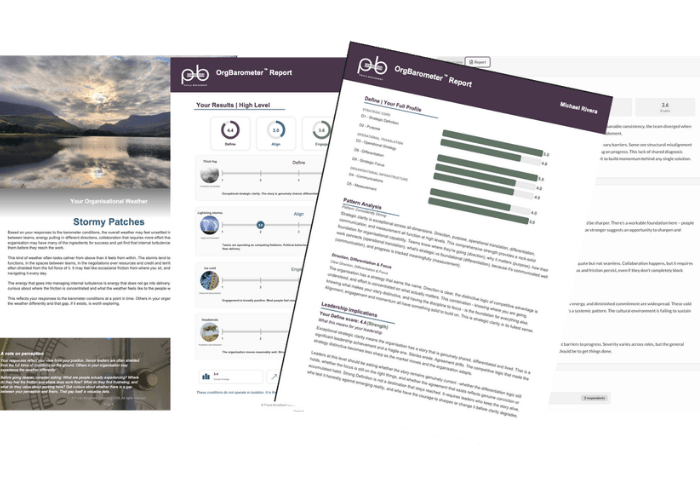
The OrgBarometer™ diagnostic maps the full picture across all four conditions. It brings clarity to this complexity. It doesn't just read what's showing up: it reads the pressure system behind it, so attention goes to where the lever actually is rather than where the symptom is loudest.
OrgBarometer™
A context diagnostic for leaders and leadership teams
Broadbent, P. (forthcoming). Reading the Weather: A Strategic Leadership Framework. Paula Broadbent Consulting.Most leaders I work with aren't short of effort or intelligence. What they're short of is an accurate read of what they're actually working with, and a clear picture of what the conditions need to look like for their strategy to work.
Without both, the response is usually the wrong one. Too fast or too slow. Focused on the visible problem rather than the one with real leverage. Treating a complex political challenge like a structural fix.
The OrgBarometer™ gives you the structured read. The ideal, the actual, the gap between them, and critically, what kind of problem the gap represents. That last part changes everything about how you respond.
The diagnostic can be completed individually, and is more powerful when completed across a team: either to surface what a leader can't see from their position, or to combine the perspectives of a leadership team into a single composite picture.
I use it with leaders in transition in Land Well, with leadership teams in Common Ground, and as a live diagnostic in the Leadership Transition Programme. It's one of several tools I use alongside coaching and team work, but it's usually where the real picture starts to emerge.
The Barometer conditions also determine what AI can do.
The same conditions that shape how well people can work shape how well AI can function. Where the conditions are strong, AI amplifies what's already working. Where they aren't, it amplifies the dysfunction. The leadership agenda and the AI agenda aren't separate. They're the same agenda.
What we do know is that it always needs a human in the loop. AI without human judgement, context and oversight fails consistently. That's not a reassuring platitude; it's what the failure data shows.
It needs the expert in the loop, and it needs to fit the organisational context it lands in. Introduce it without that, and it won't transform what's there. It will amplify it.
Like electricity and the internet before it, no-one has mapped how AI will change things. Humans need to uncover and lead the way.
McKinsey's State of AI research shows 74 per cent of organisations struggle to scale AI value, despite 65 per cent now using generative AI regularly. The RAND Corporation attributes 84 per cent of AI project failures to leadership and organisational causes, not technical ones. Bain puts transformation failure rates at 88 per cent.
The pattern across all three is the same. The obstacle isn't the technology.
Define
Your people
Without a clear and genuinely shared strategy, teams fill the vacuum with their own priorities. Effort fragments. The organisation moves, but not in the same direction.
Your AI
AI applied to an unclear strategy accelerates the wrong work. A faster mess is still a mess.
Align
Your people
When teams defend their patch rather than work across it, decisions don't stick, information doesn't flow, and coordination requires constant senior arbitration.
Your AI
AI surfaces patterns across the value chain, but only where data flows because people do. Silos block the technology just as they block the people.
Engage
Your people
Disengaged people comply at best. They don't bring discretionary effort, initiative or the kind of judgement that makes organisations genuinely capable.
Your AI
People who aren't invested in the organisation aren't invested in its AI either. Quiet resistance has a technical dimension now: shadow IT, workarounds, deliberate non-adoption.
Enable
Your people
Without the right tools, permissions and decision rights, effort gets consumed by obstacles before it reaches the work.
Your AI
Plugging AI into a system that already obstructs adds capability on top of dysfunction. The technology can only move as fast as the conditions allow.
Building the Barometer conditions isn't HR's job or IT's job. Those functions can provide expertise and resource. Building and maintaining the environment in which an organisation can execute its strategy is the work of leadership. It always has been.
A framework to put this into practice
Leadership starts out as a complicated activity. With a small team and a defined remit, you plan, work hard, and deliver. That approach works. It's what gets you promoted.
As you take on more complexity: leading leaders, running functions, owning parts of an organisation, the nature of the challenge shifts. Less and less of what you face is simple or complicated. More and more of it is complex, or even chaotic.
The instincts that served you well earlier become, at best, insufficient.
The job changes too. It stops being telic: a project with an end point, something to deliver and complete. It becomes atelic: a state of ongoing practice.
The Leadership Response Cycle™ is the framework that makes this doable. It pulls together everything you need to understand and respond to: in yourself and in your environment, into a structure for continuous practice. It's how you approach the role with curiosity rather than anxiety, adapt to what you actually find rather than what you planned for, and pull the systemic levers rather than play whack-a-mole.
The Leadership Response Cycle™
The cycle runs continuously. Each time round, the view is slightly higher, the complexity held is slightly greater, the choice of where to focus becomes more precise. This is not a loop that repeats. It is a spiral that develops. Where you enter depends on the nature of the challenge you're facing.
McKinsey's research is unambiguous: change is no longer a project; it is the operating environment. Organisations must build the capability to change continuously rather than periodically transforming and returning to stability. This requires leaders who tolerate ambiguity, model learning, admit uncertainty, and develop others faster than problems evolve. "The most successful companies are becoming learning organisations, while others are still managing technology as outsourced labour."
Eighty-eight per cent of organisations are now experimenting with AI. Eighty-one per cent report no meaningful bottom-line impact. McKinsey attributes this not to the technology but to a piecemeal approach: treating AI as a project to implement rather than a capability to build continuously.
That pattern isn't unique to AI. It's what happens every time a significant shift arrives and organisations reach for a project plan. The leaders who pull ahead are those who treat it as a practice.
Leadership at this level of complexity is genuinely demanding. AI adds to it rather than reduces it. Approached in the right way, it's also genuinely doable.
The Leadership Response Cycle™ is the scaffold. It holds together everything explored here: the identity work, the pressure and habits, the Barometer conditions you're responsible for building, the 5Ps of how you show up, the AI agenda.
Leaders who have that scaffold find something unexpected. Complexity stops being something that happens to them. It becomes something they lead through: with curiosity rather than anxiety, with intention rather than reflex.
At its best, that's not just doable. It's genuinely engaging work.
Reflection questions.
Do you see yourself as a leader? Not as someone leading a team, a project, an outcome. As a leader, for whom this practice and this cycle is the job. That is the starting point for everything else.
Do you take a structured approach to your leadership?
Do you actively manage your nervous system to avoid becoming reactive under stress?
If moving roles, have you thought through what this change asks of you personally, and professionally?
How well do you understand and manage your Barometer conditions? Are you leaving productivity on the table?
Are you and your team aligned behind a common goal?
Transition: challenge and opportunity.
In my experience, transition is the ideal time for coaching and leadership development. A change in circumstance means reflection and recalibration of approach is necessary. You have the licence to show up differently. In fact, it's expected.
When moving into a new organisation this is especially important. Bidwell's research shows external hires consistently underestimate how much tacit organisational knowledge they need to develop to be effective. Landing well takes longer than most expect. A structured approach, started early, makes a material difference.
You don't get a second chance to make a first impression.
If this resonates, Land Well is structured coaching for individual leaders navigating transition. Common Ground works with senior leadership teams. The Leadership Transition Programme is a six-month cohort for leaders who want to do this work alongside peers. Details on all three are below.
If this report has raised questions worth exploring, here's where to go next.

An honest read of where you're starting from.
The Leadership Conditions Scorecard takes around eight minutes. It will give you a read across all four Barometer conditions, where they are strong, where there is drag, and what kind of support fits where you are right now. There is no bad result. There is only an honest one.
References
Arnsten, A.F.T. (2015). Stress weakens prefrontal networks: molecular insults to higher cognition. Nature Neuroscience, 18, 1376–1385.
Bain & Company (2024). Transformations that work. Boston: Bain & Company.
Bidwell, M. (2011). Paying more to get less: the effects of external hiring versus internal mobility. Administrative Science Quarterly, 56(3), 369–407.
Bowman, C. (Cranfield University). Concept of negative delegation. Referenced in Cranfield General Management Programme materials.
Broadbent, P. (forthcoming). Reading the Weather: A Strategic Leadership Framework. Paula Broadbent Consulting.
Cashman, K. (2012). The Pause Principle: Step Back to Lead Forward. San Francisco: Berrett-Koehler.
Chartered Management Institute (2023). Better managers: harnessing the power of people management. London: CMI.
DeRue, D.S. and Myers, C.G. (2014). Leadership development: a review and agenda for future research. In D.V. Day (ed.), The Oxford Handbook of Leadership and Organizations. Oxford: Oxford University Press.
Ferris, G.R., Treadway, D.C., Kolodinsky, R.W., Hochwarter, W.A., Kacmar, C.J., Douglas, C. and Frink, D.D. (2005). Development and validation of the Political Skill Inventory. Journal of Management, 31(1), 126–152.
Health and Safety Executive (2025). Work-related stress, depression or anxiety statistics in Great Britain, 2024/25. London: HSE.
ICAEW (2025). Business Confidence Monitor: National, Q4 2025. London: ICAEW.
Institute for Employment Studies (2016). The relationship between UK management and leadership and productivity. Brighton: IES.
Kegan, R. (1994). In Over Our Heads: The Mental Demands of Modern Life. Cambridge, MA: Harvard University Press.
Kegan, R. and Lahey, L.L. (2009). Immunity to Change. Boston: Harvard Business Review Press.
McKinsey & Company (2025). The State of AI. New York: McKinsey & Company.
McKinsey & Company (2026). The State of Organizations 2026: Three tectonic forces that are reshaping organizations. New York: McKinsey & Company.
Meadows, D.H. (1999). Leverage points: places to intervene in a system. The Sustainability Institute.
Meadows, D.H. (2008). Thinking in Systems: A Primer. Edited by Diana Wright. White River Junction, VT: Chelsea Green Publishing.
Mollick, E. (2024). Co-Intelligence: Living and Working with AI. New York: Portfolio/Penguin.
Nicholson, N. (1984). A theory of work role transitions. Administrative Science Quarterly, 29, 172–191.
Petriglieri, J.L. (2011). Under threat: responses to and the consequences of threats to individuals' identities. Academy of Management Review, 36(4), 641–662.
RAND Corporation (2024). Why AI projects fail: leadership and organisational causes. Santa Monica: RAND.
Rock, D. (2008). SCARF: a brain-based model for collaborating with and influencing others. NeuroLeadership Journal, 1, 1–9.
Sadun, R. (2024). Reskilling the workforce with AI. MIT Sloan Management Review, Me, Myself and AI podcast series. Harvard Business School.
Sluss, D. (2020). Becoming a more patient leader. Harvard Business Review, September 2020.
Snowden, D.J. and Boone, M.E. (2007). A leader's framework for decision making. Harvard Business Review, 85(11), 68–76.
Torbert, W.R. and Rooke, D. (2005). Seven transformations of leadership. Harvard Business Review, 83(4), 66–76.
TUC (2026). Record levels of work-related stress in Britain's workplaces. London: TUC.
World Economic Forum (2025). The Future of Jobs Report 2025. Geneva: WEF.
World Economic Forum and McKinsey Health Institute (2026). The Human Advantage: Stronger Brains in the Age of AI. Geneva: WEF.
Wold, H.C., Rugulies, R. and Buch, R. (2022). The contagious leader: a panel study on occupational stress transfer in a large Danish municipality. BMC Public Health, 22, 1876.
Wijga, M., Beausaert, S. and Kyndt, E. (2024). What drives workplace learning: a systematic review of key antecedents. Emerald Publishing Limited.